Moisture Mitigation
Protect your epoxy investment from the #1 hidden threat — moisture vapor. We test, diagnose, and solve moisture issues before they become costly failures.
The Hidden Threat Beneath Your Floor
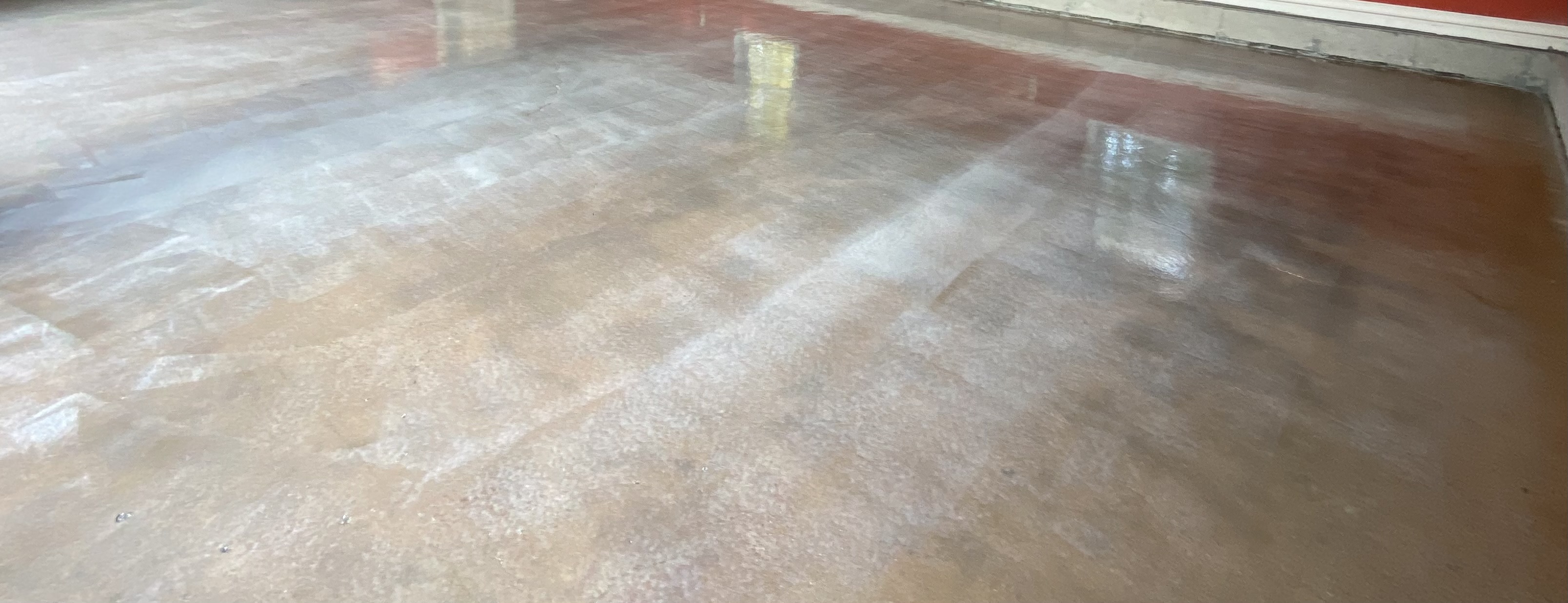
Moisture mitigation is the process of controlling and managing moisture vapor that moves through a concrete slab before installing a flooring system such as epoxy. Concrete is not waterproof; it is a porous material that absorbs and releases moisture continuously. Even if a slab looks dry on the surface, moisture vapor can still be traveling upward from the ground beneath it. This movement is called moisture vapor transmission (MVT), and if it is not properly addressed, it can create significant pressure beneath a coating system. Over time, that vapor pressure can cause bubbling, blistering, delamination, discoloration, and complete system failure.
Moisture problems typically originate from three main sources: ground moisture without a proper vapor barrier beneath the slab, high water tables, and environmental humidity during curing. Older buildings often lack an intact underslab vapor barrier, allowing groundwater vapor to migrate freely through the concrete. Even newer slabs can experience issues if the vapor barrier was punctured during construction or improperly installed. Additionally, slabs that were poured recently may still contain excess internal moisture if they have not fully cured. Without testing and mitigation, applying epoxy over these conditions can trap moisture and accelerate failure.
To avoid moisture-related failures, professional installers first conduct proper testing. The industry-standard method is in-situ relative humidity testing (ASTM F2170) to measure internal slab moisture content. This test determines whether the slab is within acceptable limits for a standard epoxy system. Skipping this step is risky because moisture issues are not always visible until after the floor fails, at which point repairs are costly and disruptive.
When elevated moisture levels are detected, a moisture mitigation system is installed before the decorative or protective epoxy layers. This usually involves a specialized two-component epoxy vapor barrier primer designed to tolerate and block higher moisture vapor emission rates. These products penetrate deeply into the concrete, seal the pores, and create a dense, impermeable layer that resists hydrostatic pressure. Some systems are rated to handle very high relative humidity levels and can dramatically reduce vapor transmission to safe levels for subsequent coatings.
An epoxy vapor barrier is important because it protects the integrity of the entire flooring system. Without it, vapor pressure can push upward against the coating, causing pinholes, osmotic blistering, and bond failure. Once delamination occurs, the only true fix is mechanical removal and reinstallation, which is significantly more expensive than installing a vapor barrier initially. In commercial and industrial settings, downtime alone can far exceed the cost of proper mitigation.
Beyond protecting adhesion, moisture mitigation also preserves aesthetics. Metallic epoxy systems, for example, are especially sensitive to moisture. Vapor intrusion can cause clouding, uneven curing, color distortion, and surface defects that compromise the high-end appearance clients expect. A vapor barrier ensures the decorative system cures uniformly and maintains long-term gloss and clarity.
Moisture mitigation also contributes to structural protection. Excess moisture moving through a slab can carry salts and minerals to the surface, a process known as efflorescence. These deposits can weaken bond strength and degrade coatings over time. In freeze-thaw climates, trapped moisture within the slab can expand and create microfractures. By sealing the slab with a proper vapor barrier system, you reduce long-term deterioration and extend the service life of both the coating and the concrete substrate itself.
Ultimately, investing in moisture mitigation is about risk management and longevity. Epoxy flooring is a premium, multi-layer system designed to perform for years under traffic, impact, and environmental stress. Installing it without verifying and controlling moisture is like building on an unstable foundation. A properly tested and installed epoxy vapor barrier system provides stability, durability, aesthetic consistency, and peace of mind. It transforms the slab from a potential liability into a reliable base, ensuring the flooring system performs exactly as designed for the long term.
What Happens Without It?
Skipping moisture mitigation can lead to:
Moisture Mitigation Services
Vapor Barriers
High-performance vapor barrier epoxy primers that seal the slab and control moisture transmission.
Moisture-Tolerant Coatings
Specialized coating systems designed to perform even in high-moisture environments.
Substrate Evaluation
Thorough assessment of your concrete slab condition, history, and moisture levels before installation.
Don't Risk Coating Failure
Let us test and address moisture issues before they become expensive problems. Free consultations available.