The Hidden Threat to Every Epoxy Floor in New England
Moisture is the single most common cause of epoxy flooring failure — and New England's climate makes it an especially critical concern. From the high water tables of coastal Massachusetts to the snowmelt and frost conditions of New Hampshire, concrete slabs throughout the region are constantly interacting with moisture. If this moisture is not identified and addressed before an epoxy coating is applied, the result can be catastrophic: bubbling, blistering, delamination, and complete system failure.
Understanding moisture vapor transmission and knowing when moisture mitigation is required can save you thousands of dollars in failed coatings and ensure your epoxy floor performs for its full expected lifespan.
What Is Moisture Vapor Transmission?
All concrete is porous. Even dense, well-cured concrete contains microscopic capillary channels that allow water vapor to move from the ground beneath the slab upward through the concrete and into the space above. This process is called moisture vapor transmission (MVT).
In small amounts, MVT is normal and does not affect most building functions. But when an impermeable coating like epoxy is applied over the concrete, the moisture vapor has nowhere to go. It becomes trapped between the slab and the coating, creating hydrostatic pressure that pushes the coating away from the concrete. This pressure causes:
Once moisture-related failure begins, the only remedy is removal and reinstallation — a costly and disruptive process that could have been prevented with proper testing and mitigation upfront.
Why New England Is a High-Risk Region
Several factors make New England properties particularly susceptible to moisture-related epoxy failures:
High Water Tables: Many areas of Massachusetts and New Hampshire have elevated water tables, especially in coastal regions, river valleys, and low-lying areas. Ground water exerts upward pressure on the slab, driving moisture vapor through the concrete at elevated rates.
Older Construction: New England has some of the oldest building stock in the country. Many residential and commercial foundations were built without modern vapor barriers beneath the slab. Without a below-slab vapor retarder, moisture vapor transmission rates are often significantly higher than in newer construction.
Freeze-Thaw Moisture Cycles: New England's winters create repeated freeze-thaw cycles that drive moisture into concrete. As the ground freezes, moisture is pushed toward the slab. When it thaws, water migrates through the concrete. This seasonal cycling can maintain elevated MVT rates even in buildings that appear dry.
Snowmelt and Spring Runoff: Spring snowmelt saturates the ground around foundations, temporarily raising the water table and increasing hydrostatic pressure beneath slabs. Garages are particularly vulnerable because they are often at grade or below grade with direct exposure to snowmelt.
Humidity: New England summers bring significant humidity. In enclosed spaces with poor ventilation — like garages and basements — humid air can condense on cool concrete surfaces, adding additional moisture to an already stressed slab.
How Moisture Testing Works
Professional epoxy flooring contractors test for moisture before every installation using the industry-standard method:
Relative Humidity Test (ASTM F2170)
This test measures the internal relative humidity of the concrete slab. Holes are drilled into the slab to a depth of 40% of the slab thickness, and humidity probes are inserted and sealed for 72 hours. The probes measure the equilibrium relative humidity within the concrete.
Most coating manufacturers specify a maximum internal RH of 75% to 80%. This method is considered the most accurate approach because it measures conditions within the slab rather than just at the surface.
When Is Moisture Mitigation Required?
Moisture mitigation is required whenever testing reveals moisture levels that exceed the coating system's tolerance. In New England, the following situations frequently require mitigation:
Even if a slab appears dry, testing may reveal elevated moisture vapor transmission that requires mitigation. This is why professional testing is non-negotiable for reliable epoxy installations in New England.
How Moisture Mitigation Systems Work
Moisture mitigation systems use specialty primers or membranes that block moisture vapor transmission while still allowing the epoxy coating to bond to the concrete. Common approaches include:
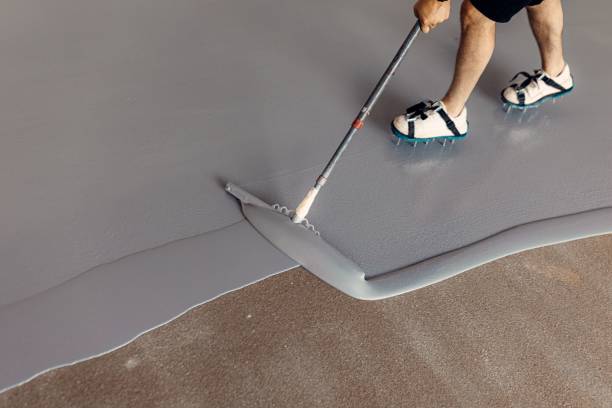
Epoxy Moisture Barriers: Two-component epoxy primers specifically formulated to block moisture vapor transmission up to 25 pounds MVER. These are applied directly to the prepared concrete surface and allowed to cure before the coating system is installed.
Cementitious Moisture Barriers: Cement-based systems that are troweled or rolled onto the concrete to create a moisture-blocking layer. These systems can handle very high MVT rates and are often used on severely compromised slabs.
Hybrid Systems: Some manufacturers offer combined primer and moisture mitigation products that serve both functions in a single application, reducing installation time and cost.
The right mitigation system depends on the measured moisture levels, the coating system being installed, and the specific site conditions.
The Cost of Skipping Mitigation
Moisture mitigation adds cost to an installation — typically $2 to $4 per square foot depending on the system and severity of the moisture condition. Some property owners consider skipping this step to save money.
This is a critical mistake. The cost of a failed epoxy installation — including removal of the failed coating, slab preparation, and complete reinstallation — is typically 2 to 3 times the cost of the original installation. Add in business disruption, lost productivity, and the frustration of a ruined floor, and the true cost of skipping mitigation far exceeds the upfront investment.
In our experience installing floors across Massachusetts and New Hampshire, moisture-related failures are almost entirely preventable with proper testing and mitigation. Every dollar spent on mitigation is an investment in the long-term success of your floor.
Trust the Testing, Trust the Process
At Epoxy Designs, we perform moisture testing on every installation throughout Massachusetts and New Hampshire. If testing reveals elevated moisture levels, we recommend and install the appropriate mitigation system before any coating is applied. We never skip this step because we know that a floor built on a compromised foundation will not perform.
Our surface preparation process — including diamond grinding, moisture testing, crack repair, and contamination removal — is designed to address every variable that affects coating performance. This is the professional difference that separates a floor that lasts decades from one that fails in months.
Contact us today for a free consultation. We will test your concrete, evaluate your moisture conditions, and give you an honest assessment of what your project requires for long-term success.